
Key points
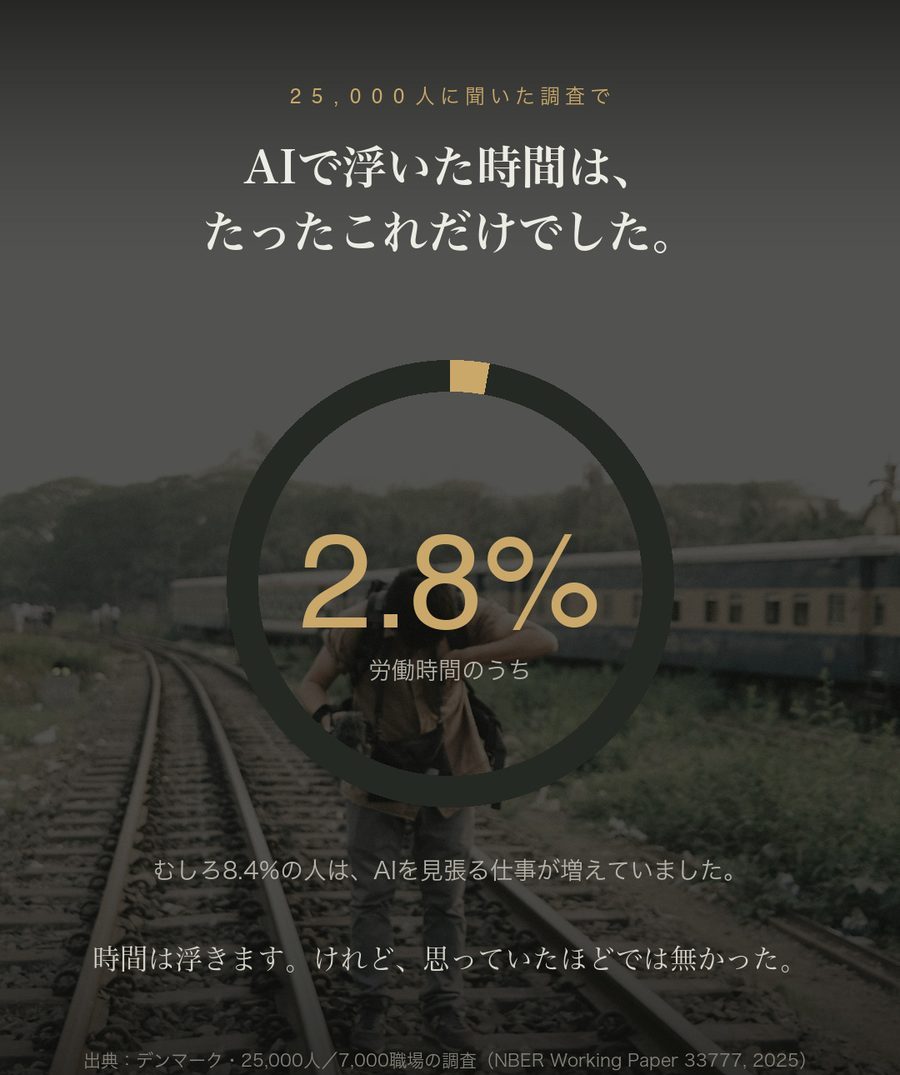
- In a study of 25,000 people in Denmark, the time saved by AI was 2.8 percent of working hours.
- In an experiment with experienced developers, they felt they had become 20 percent faster, but when measured, they were 19 percent slower.
- I leave only the functional side, content, to AI. The emotional side, works, is carried by people. I use AI to protect my time for making works.
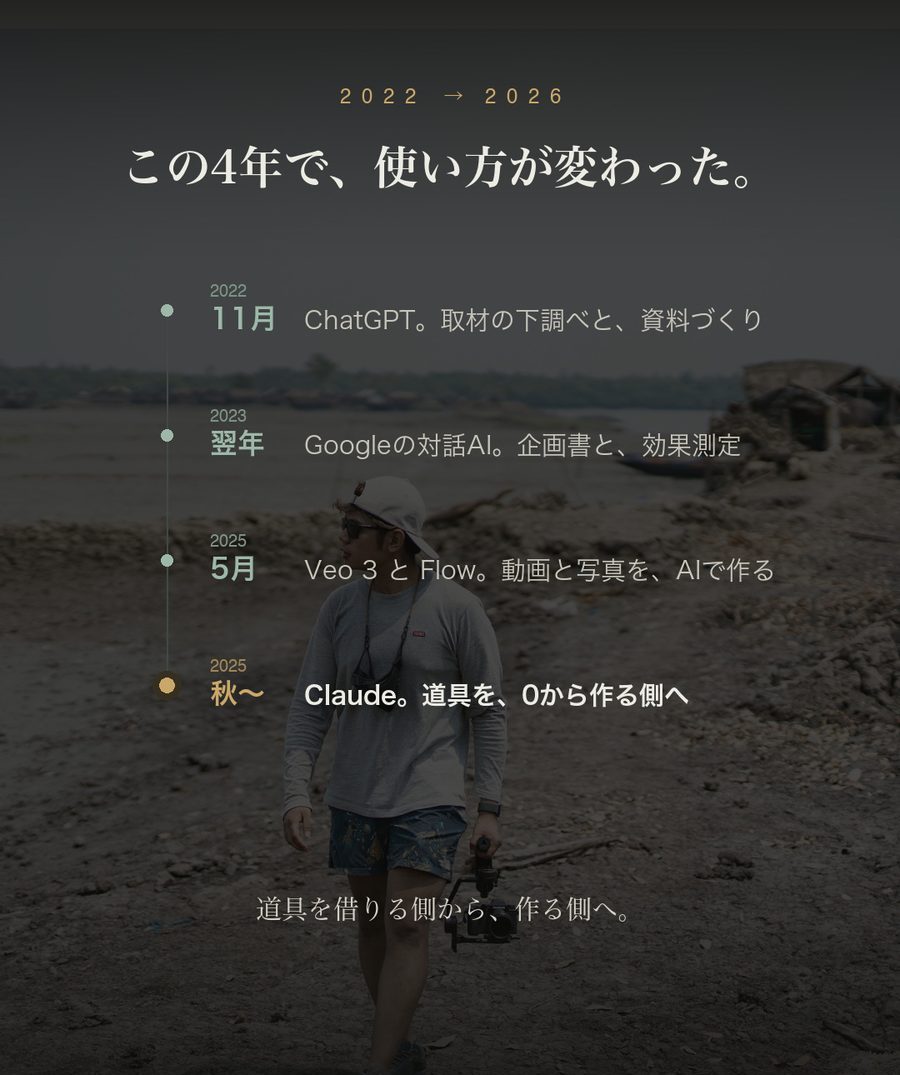
November 2022. I opened ChatGPT for the first time, for background research for a reporting trip. You type a question, and an answer comes back. That was all, but my nights of research got a little shorter.
Four years on. I want to write not about how things got more convenient, but about what AI does to people.
How my use of AI changed over four years
The following year, Google's conversational AI (now Gemini) came out and began connecting with Docs and Sheets. Working independently, I found it a partner for proposals and measuring results.
In May 2025, with Veo 3 and Flow, I began making video and photos with AI. Then, in the autumn, I discovered Claude and vibe coding.
That is when my world changed. The tools before were all good, but each had a set purpose and branched out from there. With vibe coding, you can build from zero. AI started as my research partner; now I use it to build the tools themselves.
What to leave to AI, and what not to
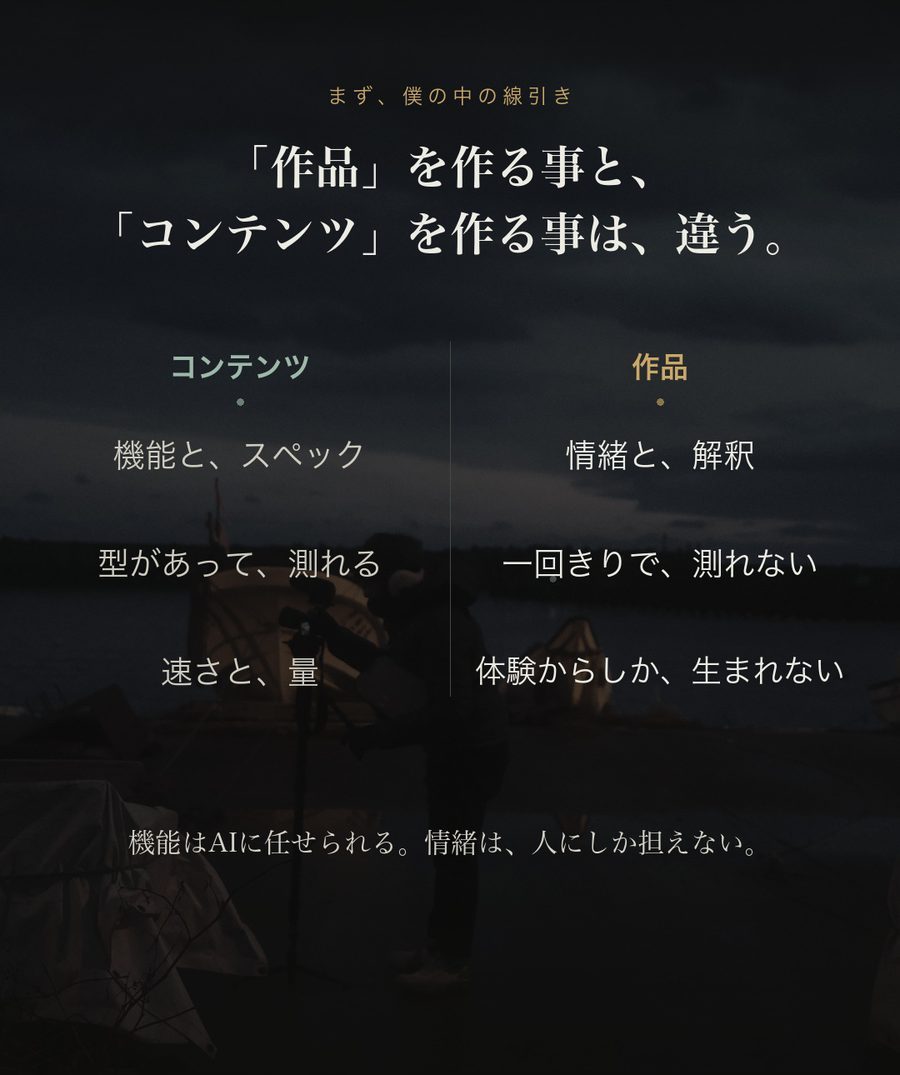
Here is where I draw the line. Making works and making content are different things.
Content has templates, can be measured in numbers, and is judged on function and specs. Works are one of a kind, cannot be measured, and are about emotion and interpretation.
Function can be left to AI.
Emotion can only be carried by people.
So the systems I built are on the content side. The emotional side, I don't let go of. When I'm asked to make a design or a website, I always include pictures drawn by people, or photos and video I shot myself. I believe emotion is born only from experience. The context of something handmade exists only there.
How far can film production be automated with AI and vibe coding?
For the content side, I built systems from scratch with vibe coding. Before I knew it there were five, all built by me.
- A system for vertical shorts: put in the footage, and it goes all the way from structure to subtitles to export
- A system that reads the patterns of videos that are growing, in numbers
- A system that wraps Japanese subtitles at phrase breaks and even measures reading speed
- A system that builds 90 percent of a long horizontal video the same way
- A system that reviews how well thumbnails and titles work, in numbers
For example, the vertical shorts system works like this.
- Ingest.Make lightweight working video and audio from the footage.
- Read.Transcribe the spoken words on my own Mac. Also pick out the cut points and a representative frame for each.
- Propose.From the text and stills, propose two or three structures. I decide which one to use, and revise it.
- Assemble.Cut, subtitle and mix the sound in one pass, and export.
- Check.Lay out the first and last frame of every cut and look at them. Transcribe the finished audio again and check that there are no words that shouldn't be heard.
My rule is that anything I couldn't measure doesn't count as a pass. The remaining 10 percent — the sound balance, the transitions, the words on screen — I decide by hand. Because people let me film them, the system is designed so video and audio never leave my machine. All I hand to outside AI is text and still images.
What the AI era requires is the ability to direct
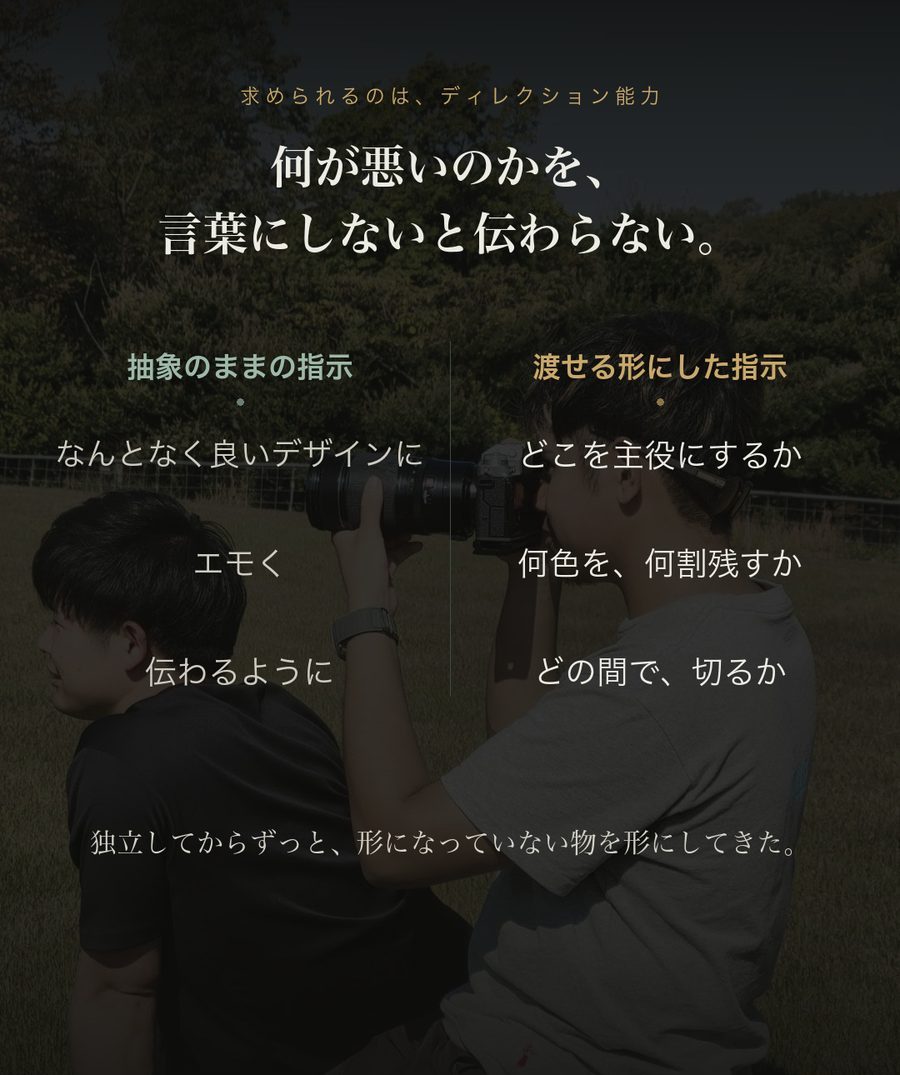
As the systems grew, I realized something. What AI needs is the ability to direct.
Since going independent in 2018, what I have always done is give shape to words that people in charge of advertising and branding have not yet put into form. Intuitive things. Abstract things. The secret recipes that designers and musicians each keep.
Without that experience, your instructions become “make it a vaguely nice design.” Too abstract for the AI to understand. And if you can't put into words what's wrong, you can't fix it either.
What to make the star. Which colors to keep, and in what proportion.
At which pause to cut.
Maybe that's why the AI images and designs flooding everywhere lately don't move me much. They came out without a recipe.
Why doesn't AI raise productivity?
I want to share one more set of numbers. A survey of 25,000 people in Denmark found that the time saved by AI was 2.8 percent of working hours. In fact, 8.4 percent of people had gained new tasks: monitoring AI and building it in.
In another experiment, 16 experienced developers did 246 real tasks. They felt they had become 20 percent faster, but when measured, they were 19 percent slower. Even when asked afterward, they hadn't noticed they had slowed down.
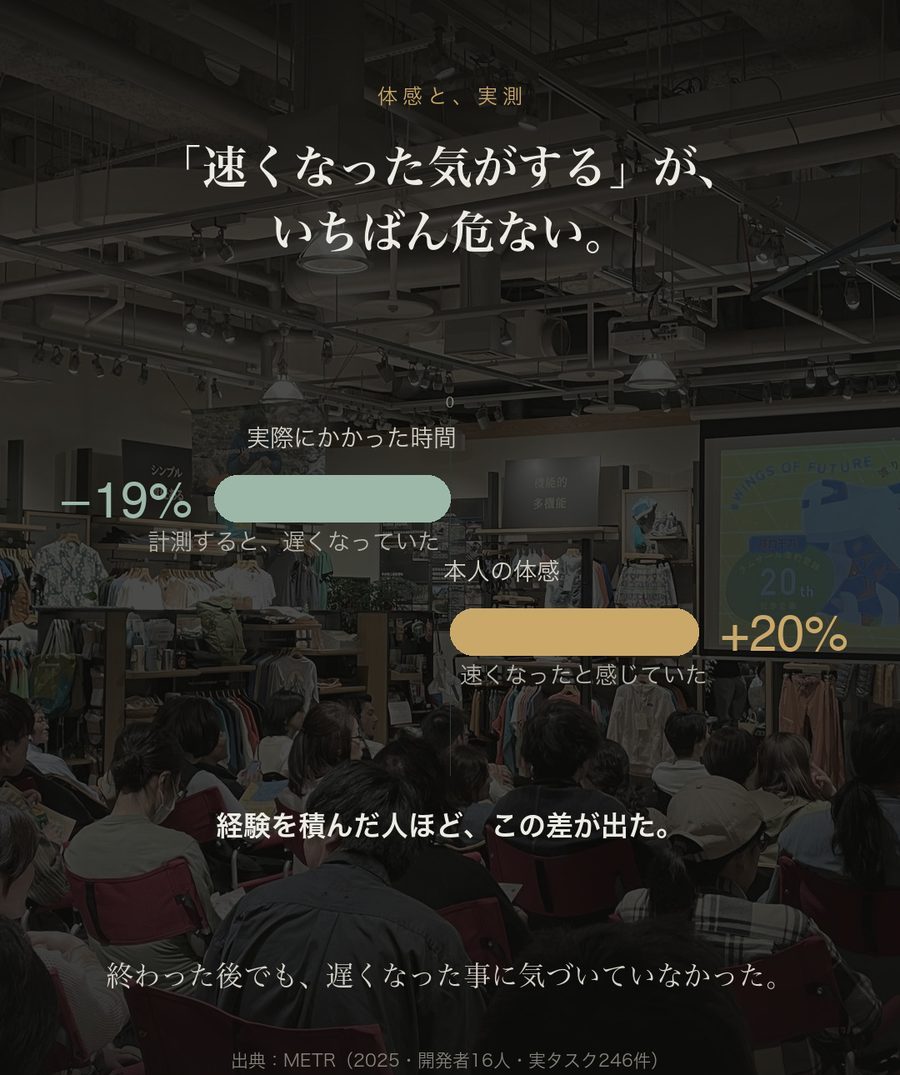
“It feels faster”
is, I think, the most dangerous thing.
When I was building my systems, I was glued to my computer all day. Things I couldn't do became possible. And then even the time I used to have, precisely because I couldn't do those things, disappeared. What are you using it for? Without an answer to that, I think AI takes over and the time that makes us human disappears.
AI fatigue: what happened to me as I kept using it
You start to think you can do anything. You start treating people like prompts. I caught myself thinking, “Why won't they just do what I said?” As you keep responding to an enormous flow of replies, being human, your brain gives out first.
This isn't from a study; it's what happened to me. (Laughs)
New models will keep coming. On September 3, 2026, OpenAI's GPT-6 Astra came out and was the talk of the town again. I think it's amazing. But trying it and saying it's amazing is completely different from building it into real work and continuing to use it.
What do I use AI for?
I use AI because I want time to make works. For when I go out to an emergency. For when we're short-handed. For when I've overworked myself and can't do my best.
The smell of mud, the time spent waiting, the times I was turned down. No one else can interpret those for me.
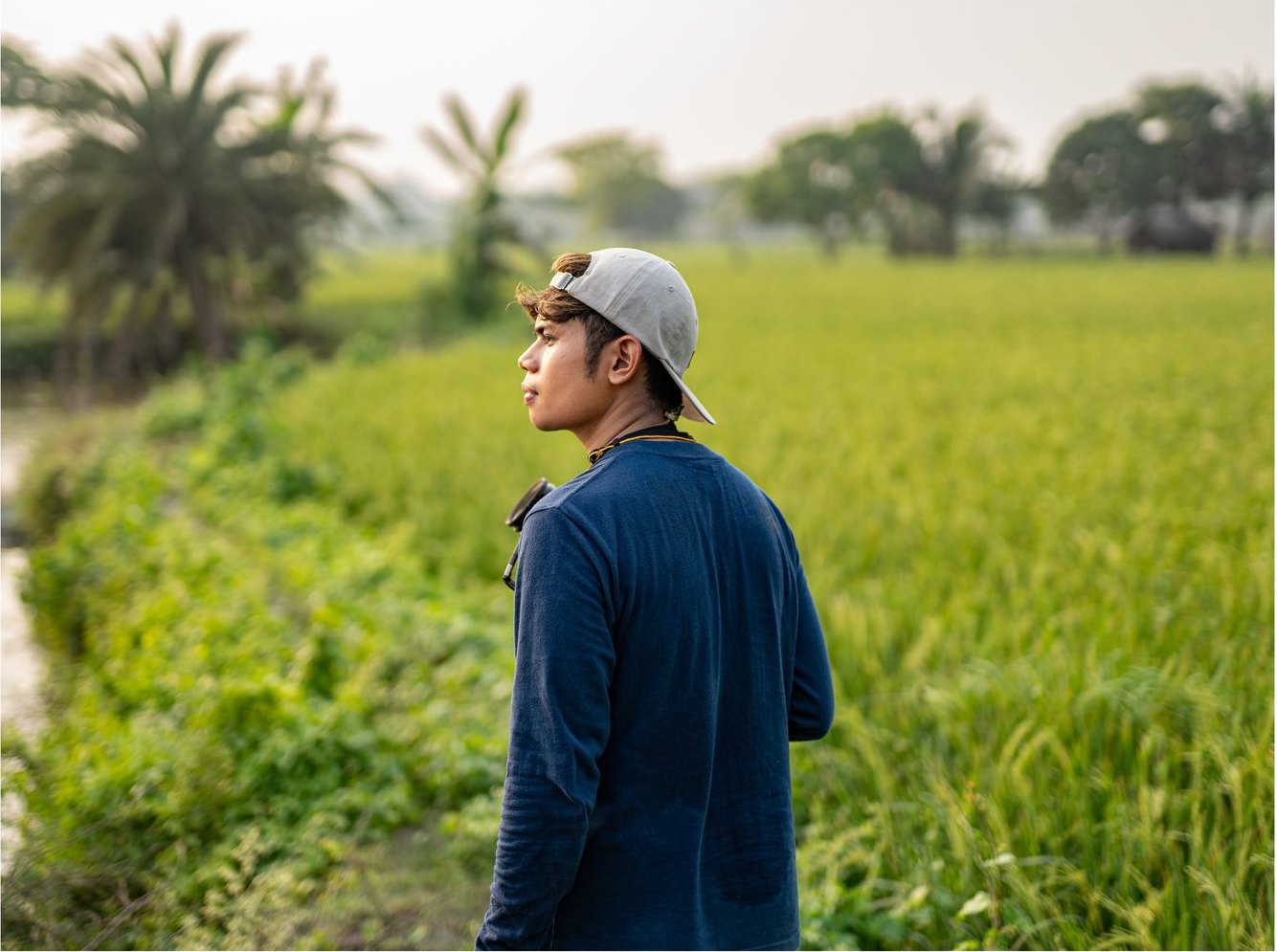
That's why I want to keep standing in the field.
May the time you free up truly be yours.

Narita Jun
Filmmaker and video journalist, born in Nagoya in 1993. As staff of an international NGO, he works in disaster response and humanitarian aid while making documentaries. Green Film Festival 2024 Grand Prize. His upbringing and work were featured in the NHK national feature “I Was Only Born.”
Sources
· Humlum, A. & Vestergaard, E. "Still Waters, Rapid Currents: Early Labor Market Transformation under Generative AI." NBER Working Paper 33777 (May 2025, revised March 2026; original title "Large Language Models, Small Labor Market Effects")
https://www.nber.org/papers/w33777
· METR. "Measuring the Impact of Early-2025 AI on Experienced Open-Source Developer Productivity." (July 2025)
https://metr.org/blog/2025-07-10-early-2025-ai-experienced-os-dev-study/
· OpenAI, GPT-6 Astra (released September 3, 2026)
This article is a rewritten version of the carousel I posted on Instagram on September 9, 2026.